VCNB Employee Celebrates New Book Release

Chat with VCNB employee Nicole Scott and you can easily see that her life philosophy is summed up in the dedication of her new book. The dedication of “Replacing Angels: When The Smoke Clears” was written to her children: “May you always aim high, stand strong, dream big and live every day with purpose.”

Nicole Scott

VCNB employee Nicole Scott holds up her new book “Replacing Angels: When The Smoke Clears.” It is available for purchase on Amazon and twenty percent of the profits on each book sold in September 2017 will be donated to a VCNB coworker who recently suffered a house fire. 

Nicole has been with the VCNB Financial Family for almost nine years, working most of that time in the bank’s Operations Department. Hustling behind the scenes with a focus on IRA and HSA administration, Nicole has endeared herself to many coworkers with her professional expertise and true passion for life. What many people don’t know is that she is a talented writer devoted to telling a meaningful story.

Nicole said that she writes to inspire people. “This is a story about loss and love and how it’s possible to rebuild and move on even after we have faced the worst. Most of us, in our lives, have been in a place where we thought we couldn’t get up and keep going. I know I certainly have,” Nicole explained. “As corny as it sounds, I think love makes all things possible.”

The journey to publishing this book was a long one. She began writing in 2012, just a year after publishing “Intuition,” a novel aimed at a teenage female reader. “I started writing this one for a somewhat older female reader, hoping to create something that would make the reader feel something.”

She wrote about three fourths of the book before life got in the way of finishing it. The mother of three said that she left it for a period of years. During that time, Nicole’s family experienced a series of tragedies including an accident that left Nicole’s own well-being in the balance. With an uncertain prognosis and too much time to think, she contemplated all the things she hadn’t done with her life.

Finishing the book was on that bucket list.

While still healing from surgery, Nicole set to work finishing her book. “I had a much deeper grasp of loss and grief. I had a better sense of who I am and what I most wanted to communicate.”

Nicole's book coverIt was published in August, just one day before another member of the VCNB family lost his home to fire. Nicole saw the aftermath of the fire and has felt drawn to help this coworker who she holds in high regard.

That’s why, through the month of September, she has committed to donate twenty percent of the proceeds of every book she sells to this coworker who is recovering from his own loss. “It’s just a terrible thing to suffer through and I want to help in any small way that I can,” she said. “You spend so much time with your work family. I definitely think of the VCNB family as my own. That probably sounds silly to some people but I think that’s the way it should be. And the VCNB family has been good to me over the years. I want to do this for someone else.”

Nicole says she has a lot to be thankful for and is excited to soon begin a new role with the bank family. She is now training to be a Retail Banker and expects to shortly be working at our Friendly Bremen Banking Center in Bremen.

Find Nicole’s book “Replacing Angels: When The Smoke Clears” on Amazon.  

A Presidential Portrait: Steve Hunter

In honor of our 150th anniversary in 2017 we are taking a look back at bank history and the people who have helped to shape our bank into the successful, secure institution that it is today. Read on to learn about one of our former presidents!

steve hunter

Steve Hunter

Steve Hunter became acquainted with Vinton County National Bank when he began serving as the bank’s Community Service Officer in 1975. At the time, asset size was about $18 million. By the time he retired in 2012 it was approximately $700 million. He was part of an era of growth and expansion that helped to shape the bank into what it is today.

A native of West Jefferson, Ohio, Steve holds a Bachelor’s Degree in Architecture and a Masters Degree in Regional Planning from Ohio University.

He served as Director of Research for the Ohio Valley Regional Development Commission prior to starting with the bank as Community Service Officer on September 1, 1975.

During his career with the bank, Steve served in a number of capacities that gave him a unique and broad understanding of how the company operates. He worked in lending, personnel, training and as the Marketing Director.

Steve was named Executive Vice President in 1984 and graduated from the ABA Stonier Graduate School of Banking in 1985. He was named to the Vinton County National Bank Board of Directors in 1987 before becoming Bank President on January 1, 1988. He served in that capacity until January 2000 when he became Chairman of the Vinton County National Bank Board.

He was CBI Vice Chairman when the Vinton County and Bremen Banks merged in 2009.

Steve has a vast knowledge of the bank’s history and can easily recite dates, stories, architectural tidbits and other information about the bank for a lot of its 150 year history. A walk through the McArthur office with Steve is like an architectural tour as he can easily recall stories from the bank’s history as they relate to the various expansion and remodeling projects.

He recalls a time in the early 1980’s when Bob Will Jr. told him to “go buy an Apple computer and make it do something.” He spearheaded the effort to bring personal computers into the bank, first using them to run monthly board reports and create spreadsheets while looking for other ways to incorporate the technology into the bank.

Steve went on to oversee numerous construction projects and to coordinate several acquisitions including those in Chillicothe, Laurelville, Logan and Richmond Dale.

One of his most significant contributions to the bank is the work he did to break into the Chillicothe market. This new, bigger market offered tremendous opportunity for growth that was close to the bank’s first home in McArthur. Today the offices in this market continue to thrive and market share is still growing.

Steve remains actively involved at the bank, serving as a Trustee for Community BancShares, Inc. His wife Trudy is retired from Vinton County Local Schools and they have one son, Marty, who is a Certified Public Accountant in New York City.

The couple reside in Chillicothe but enjoy traveling and spending winters in the South.

Learn more about VCNB Presidents! Click the links below to read about those we have profiled so far this year.

Daniel Will
Aaron Will
John L. Will
Robert B. Will, Sr.
J.G. Will
Robert B. Will Jr.
George Booth

How to Build Credit in (Exactly) 250 Words

What credit is: Your credit reports are records of how you have repaid debt in the past. Credit scores are three-digit numbers that estimate how likely you are to repay a lender or card issuer as agreed in the future. A “credit check” may look at either or both.

Why it matters: Good credit gives you a better shot at borrowing money at a favorable interest rate. It can also mean lower car insurance bills and lower or no utility deposits.

How to begin: Start using credit, which is easier said than done. See if you can get a credit card, perhaps a secured credit card to start. Becoming an authorized user on someone else’s card may help. Student loans, car loans and credit-builder loans also build credit history.

Do I have to go into debt? No. One of the best ways to build credit is using a credit card lightly and paying the balance in full every month.

Understand your score: Most credit scores are on a scale from 300 to 850. It’s smart to monitor your score; you can get a free credit score from some credit card issuers or personal finance websites, like NerdWallet.

Know what affects your score: The biggest things you can do to boost your credit are:

  • Pay bills on time, without exception
  • Use little of your credit limit (under 30%, and under 10% is better)

Other things help, too:

  • Have both credit cards and loans
  • Keep older accounts open
  • Limit applications for credit

Bev O’Shea is a staff writer at NerdWallet, a personal finance website. Email: boshea@nerdwallet.com. Twitter: @BeverlyOShea.

The article How to Build Credit in (Exactly) 250 Words originally appeared on NerdWallet.


.

How Costly Is Bad Credit? Many Don’t Know, Survey Shows

It’s 2017: Do you know what your credit score is?

Good credit is important for many reasons beyond qualifying for the best loan rates. And the very first step in building it is knowing your starting point. But a NerdWallet survey finds that while more than a quarter of Americans (26%) check their credit scores monthly or more often, nearly 1 in 8 (12%) have never checked their scores.

In an online survey of more than 2,000 U.S. adults, commissioned by NerdWallet and conducted by Harris Poll in April 2017, we asked Americans what they knew about the impact of bad credit, as well as factors that do and don’t affect credit scores. Here’s what we learned:

  • About half of Americans (49%) don’t know that having bad credit can limit a person’s options for cell phone service. There are ways to get a cell phone without a credit check, but consumers with poor credit have fewer options.
  • Almost a quarter of Americans (23%) think a person has just one credit score. Most consumers have many scores, and they can vary based on the information used to calculate them. The score provider and score model your lender will consult depends on the reason you’re looking for credit: there are auto-specific and mortgage-specific scores, for instance.
  • More than 2 in 5 Americans (41%) think carrying a small balance on a credit card month to month can help improve a person’s credit scores. This is a common misconception. To avoid interest charges, pay off credit cards each month.

CD-0402-CCD-ItAddsUpStudy_Infographic_Final

What you don’t know about credit can cost you

About 40 million Americans have a FICO credit score lower than 600 [1], and many might not understand the impact it can have on their everyday lives, even if they’re not applying for loans or saddled with high-interest debt.

The everyday effects of bad credit

Having bad credit is expensive, and not just because of the high interest rates lenders charge. More than 2 in 5 Americans (43%) don’t know that having bad credit can negatively impact the price of car insurance, and more than half (52%) don’t know that it can negatively impact the cost of utility deposits. These expenses are often cheaper or nonexistent for those with excellent credit, even though they don’t involve borrowing money.

Bad credit can even limit housing opportunities. Many landlords check applicants’ credit reports, but almost a quarter of Americans (23%) don’t know that having bad credit can negatively impact a person’s ability to rent an apartment. And almost half (49%) don’t know that bad credit can limit the ability to get a cell phone. Consumers with bad credit might be restricted to prepaid phones and miss out on carriers’ best plans. It might even be challenging to get certain jobs with poor credit.

Bad credit means fewer credit card choices

More than 1 in 5 Americans (21%) believe that a person with a credit score above 600 will qualify for any credit card he or she wants. Another 40% aren’t sure if a score above 600 qualifies a person for any credit card. In fact, 600 is a below average score and won’t give consumers access to most of the cards on the market.

Consumers with excellent credit have almost eight times as many credit card options as consumers with bad credit do. [2] Those with bad credit miss out on the cards with the best rewards and lowest interest rates, as well as the best purchase protections and travel benefits.

Misconceptions surround credit scores

Why do so many Americans have bad credit? Here’s one possibility: Increases in the cost of living have outpaced income growth for the past 13 years, according to NerdWallet’s annual household debt study. Many consumers might be maxing out credit cards to bridge the gap and then falling behind on payments or defaulting.

Another theory is that Americans simply don’t understand how credit works. Our survey found many misconceptions about credit scores, including the number of scores people have and the factors that go into them.

What’s a credit score?

A credit score is a three-digit number, usually on a scale of 300 to 850, that estimates how likely someone is to repay borrowed money. If you make regular payments to a lender — on a credit card or auto loan, for example — you probably have credit scores.

More than 1 in 10 Americans (11%) think everyone starts out with a perfect credit score. Actually, you must build your scores from scratch — but they don’t start from zero. Want to measure your progress? Your scores won’t necessarily be listed on your credit report, although almost two-thirds of Americans (64%) think they are. The free credit reports available once per year from AnnualCreditReport.com don’t include scores. However, you can get free scores from various sources, including NerdWallet.

The components of a credit score

Five basic factors go into most credit scores: payment history, credit utilization, length of credit history, types of credit in use and new credit.

Payment history: One of the best things you can do for your credit scores is to make payments on time, 100% of the time. You’re best off paying your entire credit card balance, but at least pay the minimum by the due date. Creditors won’t report payments that are only a few days late to credit bureaus, but pay 30 days or more late and you can tank your scores.

Credit utilization: This refers to the proportion of your available credit you’re using at any given time. Between 1% and 30% is ideal, but people misunderstand these numbers.

Possibly because using credit helps your scores more than not using it at all, more than 2 in 5 Americans (41%) think carrying a small balance from month to month can help improve a person’s scores, while one-fifth (20%) think it can hurt it. In fact, whether someone carries a small balance probably doesn’t affect his or her scores at all.

“The idea that you have to carry debt to have good credit is a dangerous, expensive myth that needs to die,” says NerdWallet columnist Liz Weston, author of the book “Your Credit Score.” Carrying a balance will mean you pay interest, but it probably won’t have any impact on your credit — just your wallet.

Length of credit history: This includes the total time you’ve had credit — starting from your first credit card or loan — and the average age of all your credit accounts. It’s a good idea to keep your oldest account open and avoid closing other older, unused accounts unless you have a good reason, like they charge annual fees or you need to shed a joint account. If you do choose to close other accounts, keep length of credit history in mind to limit the negative effect on your scores.

Mix of credit accounts: Having a mix of account types doesn’t have a large impact on credit scores, but it might be helpful to have both revolving accounts, such as credit cards and lines of credit, and installment loans, such as mortgages, auto loans or student loans. You can build and maintain good credit with just one type of account.

New credit: The final factor concerns the number of new accounts you’ve opened or applied to open. When you apply for a credit card or loan, a “hard” inquiry appears on your credit file. Checking your own scores results in a “soft” inquiry that won’t hurt your credit. But hard inquiries aren’t great for your scores, so you’ll want to limit the number of applications you submit.

The exception is when you’re “rate shopping” for a mortgage or auto loan. In these cases, it’s smart to apply at several different lenders to get the best rate. The credit bureaus count multiple inquiries as a single inquiry as long as they’re made within a certain time frame, usually a few weeks.

How to improve bad credit

Improving your credit means working on the five factors above. However, you also might be able to improve your credit by catching mistakes on your credit reports. Most consumers have one at each of the main credit bureaus: Experian, TransUnion and Equifax. You can obtain each of these reports for free once per year.

Once you receive your reports, read each one closely and dispute any errors. Incorrect information could hurt your credit, denying you access to low loan rates, superior credit products and other benefits of good credit.

People trying to build credit commonly run into a catch-22: They need a loan or credit card to increase their scores, but they can’t get approved for a loan or credit card because their scores are low or nonexistent. For example, it’s hard to find good credit cards for bad credit.

Those with poor credit have a few options:

Credit-builder loansThese loans typically have low interest rates, regardless of your credit scores. But there’s a catch: You don’t receive the money from the loan until you pay it off. These loans exist solely for the purpose of building credit. The lender puts the money into a savings account, and you can claim it once you’ve paid the balance in full. The bank will report your payments to the credit bureaus, which should help your scores, provided you’ve made all the payments on time.

Secured credit cardsWith a secured card, you put down a security deposit that’s usually equal to the card’s credit limit, but sometimes is less. This reduces the issuer’s risk. Not everyone who applies for a secured card gets approved, but they’re still a good option for those with bad credit.

Secured cards aren’t prepaid, so it’s critical that you pay off your charges each month. After “graduating” to an unsecured card or closing the account in good standing, you’ll get your deposit back.

Secured personal loans: If you want to build credit but also need a loan, a secured personal loan might be the way to go. These allow you to borrow against a car, savings account or other assets, including such things as a recreational vehicle or furniture. The rate will likely be higher than it would be on a credit-builder loan, but you’ll have access to the loan money.

“You don’t need to carry credit card debt to have great credit scores,” Weston says. “But you do need to have credit accounts and use them responsibly.”

Methodology

This survey was conducted online within the U.S. by Harris Poll on behalf of NerdWallet from April 6-10, 2017, among 2,250 adults ages 18 and older. This online survey is not based on a probability sample, and therefore no estimate of theoretical sampling error can be calculated. For complete survey methodology, including weighting variables, please contact cc-studies@nerdwallet.com.

Footnotes

[1] According to Ethan Dornhelm, principal scientist at FICO, there are about 40 million U.S. consumers with credit scores below 600. There are an additional 53 million Americans who can’t be scored because they have too little information on their credit file or no credit file at all.

[2] According to the NerdWallet database of more than 1,200 cards, there are 7.7 times as many cards available to those with excellent credit compared to those with poor/bad credit.

How Much 20-Somethings Should Save

Your 20s may seem like an odd time to think of retirement, but it’s actually the perfect moment to start planning for your later years. That’s because the earlier you start saving, the more time your money has to grow.

Savers who begin setting aside 10% of their earnings at 25, for example, could amass significantly more by retirement age than those who wait just five years to start saving. You can use online calculators to see how much starting saving now can produce once you reach retirement.

Building a nest egg on a starter salary and a shoestring budget can seem daunting, though. Focusing on the incremental savings, rather than the goal, can help your savings objectives feel more manageable.

How much to save for retirement
For those earning around $25,000 a year, the median income for 20 to 24 year olds in 2015, saving the recommended sum of 10% amounts to a little more than $200 a month.

It may seem like a reach, but consider this: If you start saving $100 a month at age 25 and invest it to return 7.7% a year — the average total return of the Standard & Poor’s 500 Index of U.S. stocks over the past decade — you’ll have more than $378,000 available at retirement age. And it could be tax-free.

If you wait until you’re 30 to start and save the same monthly amount at the same rate of return, you’ll wind up with less than $253,000.

Several vehicles can help you build a retirement fund. A 401(k) contributory plan, typically offered by your employer, is often the most convenient and easily accessible of these. Contributions you make usually aren’t taxed, which helps reduce your income tax liability.

Pre-tax 401(k) accounts make up around 80% of retirement plans offered by employers, according to the American Benefits Council. Roth 401(k) accounts are another option, though these are less widely available, and money contributed to a Roth 401(k) account goes in after it’s taxed. Money withdrawn from this type of account — including earnings — is usually tax-free.

Companies that offer a 401(k) plan often match employee contributions, up to a certain percentage. This is essentially free money toward your retirement.

If your employer will match your contributions, try to take full advantage and commit a large enough percentage to get the full benefit.

Beyond a 401(k), individual retirement accounts, commonly referred to as IRAs, offer another solid option. There are two types: traditional and Roth.

Money put into a traditional account is tax-deferred, similar to funds put in a traditional 401(k) plan. That means those funds aren’t taxed until they’re taken out. But typically any earnings you make with the money are also subject to income taxes on withdrawal.

Money put into a Roth IRA has already been taxed when you earn it, so there’s no immediate tax benefit. When it’s time to withdraw the cash, however, you usually don’t pay taxes on it. And anything the money earns also can be taken out tax-free.

Contributions to both types of IRAs are currently capped at $5,500 a year for those under age 50, and $6,500 for older workers.

How much to save for emergencies
In addition to retirement, it’s also wise to save for a rainy day. Ideally, your emergency fund should be enough to cover three to six months of living expenses.

Some experts suggest setting aside even more for savings and investments: 20%. That’s roughly $415 a month on an annual income of $25,000.

That’s not always feasible, especially if a big chunk of your monthly income goes to student loan and credit card payments. Consider saving what you can, even if it’s just $10 a month.

Making a habit of saving now could serve you well down the road. And, as your income increases, the percentage you save can as well.

© Copyright 2016 NerdWallet, Inc. All Rights Reserved


A Quick Look: Simplify Your Banking

Most of us lead busy lives. In the spirit of Simplify Your Life Week, we wanted to do a quick summary of some ways you can simplify your banking and {hopefully} free up time for things that are important to you.

Online and Mobile
Gone are the days you have to wait for the mailman to bring your monthly statement. You can still do this but you can also just log in to your online account and see your current balance, past statements, current statement and even pay bills, open an account or prequalify for a loan. It’s free and easy to use our website, plus it gives you greater control over your own money. With VCNB Mobile, you’ll find a one stop shop for your quick banking needs. This is free app gives you access to your deposits and loans from your mobile device. Here you can also pay bills, transfer funds and even deposit a check. It’s like carrying around the bank on your phone.

Want to know more? Here are some specifics!

Online Bill Pay
Many customers seem to think Online Bill Pay is the greatest thing since sliced bread and we are inclined to agree. Set up recurring bills to automatically pay at your convenience or log in and pay a single bill. Either way, it saves using checks and stamps. It also guarantees your payment will be taken from your account when you say. It’s free as long as you use it at least once a month. The great thing about Bill Pay is that it requires so little effort and time to keep paying bills within your complete control.

Popmoney® personal payment service
While Bill Pay helps you pay bills, Popmoney allows you to send funds electronically to individuals. All you need is the person’s email address or mobile phone number. They will receive a text or email notification that your money is waiting for them. They can deposit the money into the checking or savings account of their choice.

Mobile Deposit
Have a check but no time to hit the bank? Deposit it using VCNB Mobile and the camera on your mobile device. You can deposit funds in to the VCNB checking or savings account of your choice for free!

Account Alerts
You don’t even have to log in to keep up with activity related to your checking account, savings account, certificate of deposit or loan. There are nineteen notifications to choose from, allowing you to receive an email or text for activity that interests you. Want to know when your debit card is used or when your checking balance dips below a certain amount? Request reminders for when your loan payment is due or late and even get an alert when your CD is about to mature. Sign up for this free service online.

A Few More Things
Our website and mobile app provide a host of other ways to simplify your banking and save you money. For example, if you’re in the market for a new home, use our online pre-qualification to learn how much you can afford. Open accounts online, track the UChoose Rewards® you earn with Rewards Checking, request a credit increase for your credit card and even chat online with someone in customer service!

Life is too short to waste time on banking. Streamline your banking and your money management with these and other great products at VCNB!

Small Business Spotlight: Holzapfel Family Health Care/Urgent Care

Small businesses are important to communities and running a small business is tough work. That’s why we feature a small business in one of our communities every month!

vicki holzapfel

Vicki Holzapfel is pictured in an exam room at Holzapfel Family Health Care/Urgent Care in Jackson.

Jackson County’s newest health care facility offers patients a place to go for quick but compassionate health care from a local professional. Holzapfel Family Health Care/Urgent Care opened on July 10 with a ribbon cutting by the Jackson Area Chamber of Commerce and the longtime desire of one local woman to own her own business.

Owner Vicki Holzapfel is a Nurse Practitioner with over thirty years of experience in the health care field. She began her career as a Registered Nurse in 1983 after earning an Associates Degree at the University of Rio Grande. She went on to earn a Bachelor’s Degree from Capitol University to become an RN while a working mom. In 2001, she graduated from Wright State University with a Master’s Degree to become a Family Nurse Practitioner.

Holzapfel explained that her thirty plus years in the medical field have given her the knowledge, connections, love for her work and confidence needed to strike out on her own. She has worked as an intensive care nurse, an emergency room nurse and in nursing management. Since becoming a Nurse Practitioner, she also has worked in pediatrics for eleven years, the ER for two years and internal medicine for two years.

“I have done a lot of different things,” Holzapfel exclaimed.  She went on to discuss some of the benefits of her varied career. “Since 1983, I’ve met a lot of people in my field and I’ve maintained good relationships with them. Even if I don’t know the answer to a question, I am always able to refer patients to someone who will be able to address their unique situation.”

When longtime friend and colleague Sherry Russell invited Holzapfel to join her at Russell Family Health Care in Jackson, she thought it was the right move. Then when Russell offered to sell the business to Holzapfel earlier this year, she knew the time was right. “Everything just fell into place. My husband Rex has wanted me to have my own practice for a long time. It just felt like it was the right time to stretch my wings a bit,” she said.

In addition to employing her decades of medical experience, Holzapfel said she is thrilled to use her people skills and the business knowledge she learned from her late father Sam Hatley. Her father was the Vice President of Manufacturing for Austin Powder Company in Vinton County. She credits him for much of her personal development and caring for others. “Dad taught me to appreciate people, to take care of people. The employees and the people around you are the most important thing,” she said. “He instilled in me to be good to people, to be kind to people.”

At this time, Holzapfel employs three people and is able to provide care for all ages by appointment or by walking in. They can perform sports physicals, do lab draws, administer medication, do flu/strep and mono testing, drain abscesses, give flu shots, EKGs, referrals and more.

Construction for a planned expansion will start in August and will provide for growth in both space and services. The two room clinic will grow to six rooms and will allow them to perform Department of Transportation physicals and aesthetic services like Botox injections and Dermal Filler injections.

“I’m just so happy to be here, to be taking care of people the way they need to be taken care of. I want to treat them right,” she said.

Holzapfel and her husband Rex have two children and four grandkids. They enjoy breeding German Shepherds and are excited to soon have puppies.

Holzapfel Family Medical Clinic/Urgent Care is located at 345 East Main Street in Jackson. Hours are Monday through Thursday 10 a.m. to 8 p.m., Friday 8 a.m. to 5 p.m. and Saturday 8 a.m. to noon. Walk in or call 740-577-3043. Learn more at their website and follow them on Facebook.

VCNB Business Banking: On Your Corner and In Your Corner

If you own or manage a business you could probably write a book about everyday headaches like tax laws, payroll and managing people.

However, we don’t want your banking experience to be a chapter in that book. In fact, we want to make your life easier and banking more pleasant. That’s why we are constantly looking for better ways to serve our businesses customers. Just this year we restructured our business accounts so that we can do just that.

As your community bank, we want to help your business grow and prosper. We want banking to be one of the easiest things you deal with in your fast-paced day.

In fact, we don’t want you to think of us just as bankers who handle paperwork and wait on customers. We want to be your ally.

We want to help you build your business and we want to see you succeed. As a leader in advanced technology and new services, we help large and small businesses every day. As a community bank, we offer personal service that will make you feel comfortable and appreciated.

At VCNB, you can have a conversation with a real person who can address your real problems and help you set up services that will make your real life a little easier. We know you’re busy. We know you’re up early and hard at work before a lot of folks have their first cup of joe. We know your schedule isn’t always flexible. That’s why we keep skilled people on hand to assist with your business banking needs, people who will respect your time and deliver the solutions you need.

Speaking of solutions – did you know that you can deposit checks from the comfort of your office? No need to leave work for a bank drop when you can do it while minding the shop. Did you know that we offer a payroll service or that we now have a Rewards Checking account for businesses? We even have a fraud detection tool that protects against altered checks and counterfeit check fraud. The list of perks that come with our new Business Rewards Checking and Business Rewards Checking Plus is too long to cover here!

We like to say that we’re “On Your Corner and In Your Corner.” This isn’t just an advertising line. With sixteen convenient locations, there’s a VCNB banking center somewhere close to you. Stop by the bank in your neighborhood or give us a call to get started. Learn more about business banking opportunities by visiting our website.


Presidential Portrait: Remembering Bob Will

Modern bank customers and employees speak fondly of a man who began life with journalistic aspirations but who instead became a community banker.

Robert Burson Will, Jr. was born December 31, 1929 to Robert Buskirk and Helen Burson Will. He was a McArthur native and 1947 graduate of McArthur High School. Bob graduated Phi Beta Kappa from Miami University of Oxford in 1951 where he was a member of the Sigma Nu Fraternity. He served the United States Navy from 1952 through 1954 when he went to work for the bank, starting out as a Teller.

Bob WillRobert Jr., known better as Bob or Bobby, started as a bank employee in 1954 and became a Vice President in 1963. This quiet career beginning led to great things as he went on to serve as bank President and Chairman of the Board of Directors. Under his leadership, the bank grew from offices in McArthur and Wilkesville to thirteen banking centers in six Ohio counties.
Bob was named President on June 6, 1978 after J.G. Will stepped down to become Chairman of the Bank Board. Bob would later follow in J.G.’s footsteps to serve as President of the Bank Board as well as President and CEO of Community Bancshares, Inc.

He worked with J.G. to expand the bank into Wilkesville and was instrumental in the creation of Community Bancshares, Inc. This holding company positioned the bank to purchase other banks. Under his leadership, the bank expanded into Fairfield, Ross and Hocking counties, growing to thirteen offices at the time of his death.

Bob supported anything that might improve the banking experience for the customer. He was a driving force behind the creation of The Depot Drive-Thru, the bank’s embrace of the ATM and the new, exciting ways that computers could make banking better. He is said to never use a computer but was excited to introduce computers into the bank.

He was also known to have a knack for understanding how to work with available resources and finding ways to grow. Bob had a flair for the written word, typing memos and essays on the typewriter in his office and leaving behind a trove of writings that remain relevant to young bankers today. With a genuine love for marketing and a flair for the imaginative, Bob encouraged unique campaigns that kept the customers talking.

Like all who held this post before him, Bob worked for the betterment of Vinton County seeking ways to improve local schools, recreation and the economy. He was involved in everything from school facilities improvement to the creation of the Vinton County Airport.

Bob and his wife Ruth Dunlap Will had five children: Emily, Kathleen, Laura, Margaret and Thomas. Some of his children and grandchildren continue the family legacy today, including Tom, who today serves as CBI Chairman.

Bob was a member of the Ohio Forestry Association and served on the University of Rio Grande Board of Directors. He graduated from the Stonier Graduate School of Banking. He was a member of Delta Lodge #207 F. & A.M., Scottish Rite Valley of Columbus, was a 33rd Degree Mason, a member of McArthur Chapter #102 Royal Arch Masons, Trowel Council #71 Royal and Select Masons and Jackson Commandery #53 Knights Templar. A lifelong member of Trinity Episcopal Church in McArthur, he enjoyed hours spent with his horses, hunting dogs and family picnics at his cabin.

Bob died November 28, 2007 at the age of 77.


VCNB Day To Feature Nineteenth Century Fun

Our bank was born less than two years after the Civil war ended. At the time, the country was still recovering from war and the town of McArthur was a booming place that needed a bank. As it turns out, two banks opened that same year. The Vinton County Bank opened in January 1867 and the bank of Will, Brown and Company opened shortly after. The following year, the two banks merged to form one, keeping the name of the first bank while adopting the leadership of the second.

It’s a story we have told a lot this year as Vinton County National Bank has celebrated its 150th anniversary throughout 2017.

In a few weeks, we’ll have our biggest celebration in our hometown over the 4th of July weekend. We have partnered with the Vinton County High School Athletic Boosters to help them with their annual 4th of July celebration. In doing so, we’re sponsoring a concert by Nashville recording artist Jason Michael Carroll, sponsoring a big hot rod and vintage car show and a host of other things. There will be an open house at the bank and we’ll be offering free wagon rides with John Hutchinson following the parade where we are the grand marshals! Thanks to the Boosters for allowing us this honor!

On Sunday we’re doing something extra special. The Boosters were kind enough to make this Vinton County National Bank Day at the Festival. While they’re having tournament games, vendors and food, we’ll be doing something a little different by embracing our post-Civil War roots. Here’s what we’ve got going on starting at 1 p.m.:

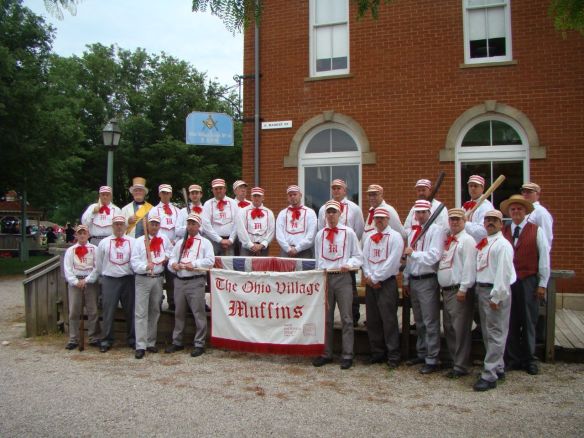
Ohio village muffins19th Century Ball Games – Have you ever thought about how baseball was originally played? The Ohio Village Muffins Men’s Baseball Team and the Ohio Village Diamonds Women’s Team will put on a good show as they play bankers and other community members in nineteenth century style games! The ladies play in skirts and the gentlemen play in long sleeve wool shirts! They didn’t have mitts or protective gear back then and they played by much different rules than we have today! An announcer explains the rules and etiquette and helps spectators understand what’s going on! The ladies play at 1 p.m. and the gentlemen at 3 p.m.

CusterReenactors and Music – Have you ever wanted to meet a President? Ohio’s Premier Abraham Lincoln impersonator will be joining us to talk with folks and pose for pictures. We also have Ohio native General George Armstrong Custer coming for the day and a reenactor who will set up camp, talk with folks about the life of a soldier, do some demonstrations and pose for pictures. Finally, Ohio musician Steve Ball will join us for the day. He and his wife play Civil War era music on period instruments. They do a beautiful job and will surely provide some good entertainment for us all.

Giveaways – The first 150 kids to arrive that day will receive a commemorative 150th piggy bank. One of those banks will contain $25 to help one lucky youngster jump start their savings! We’ll also have some giveaways for adults.

Travis West and OSU Extension will be there to offer old fashioned games for kids and the Vinton County High School Athletic Boosters will be selling ice cream sundaes in addition to all the other fun activities and food the Boosters are planning!

Bring some sunscreen, a lawn chair and a few bucks if you want to buy lunch or snacks. We’ll take care of the entertainment! Visitors will also have access to restrooms inside the high school as well as a shady spot under our big tent to relax and enjoy the day. Want to know about other things happening that weekend? Click here to learn more about what we’re doing and check out the full festival schedule below!

2017 4th schedule_Page_1

2017 4th schedule_Page_22017 4th schedule_Page_3