Money Tools To Help High School Grads Succeed

Celebration Education Graduation Student Success Concept

Graduation season has arrived, ushering into the world a new group of young people who are headed into the workforce and into higher education. If you’re among the scores of high school graduates this season, there are some things you’ll need to succeed financially.

Checking Account
Everyone needs a checking account. It will keep your money safe and accessible.  Not only is money in the bank protected from flood, fire and robbery, it is also FDIC insured.* This means your money is safe until you are ready to use it. Yet it is still easily accessible for online bill paying, for purchases with debit card or check and for withdrawal from an ATM, bank, or cash back in a store.

Savings Account
One piece of advice we hear from older folks all the time is to start saving early. Even if you don’t have a lot of money, it’s important to stash away as much as you can every chance you get. A VCNB Passbook Savings account gives you a safe place to keep your savings separate from the spending money in your checking account.

Online and Mobile Banking
You are on the go a lot. That means you will want to have quick access to your money. You’ll want to know how much you have, be able to schedule bill payment online and transfer funds between your checking and savings account with ease. Having online banking and mobile banking, like VCNB Mobile, your accounts are at your fingertips 24 hours a day.

Debit Card
As mentioned above, you need to be able to buy things. A debit card is safer than carrying around a pocketful of cash. Most retailers today accept plastic making it the most popular way to pay in most stores and restaurants.

Popmoney
Here at VCNB we offer something called Popmoney® personal payment service that allows customers to send money to another individual with just their mobile phone number or email address. If you’re headed off to college, this is an easy way for parents or grandparents to send their favorite college student a little pizza money from time to time.

Here’s a little more food for thought – You may think these crazy bankers have unrealistic expectations. You are just starting out and don’t have much money to save or to spend so you’re wondering why all this is so important. We’ll tell you why: when you’re young and without resources is a great time to learn how to do more with less. We find that people who learn to manage a bank account when they have limited funds are more likely to manage their money well when they are more established with a full time job and higher income. When you have a small balance and just a few bills is a perfect time to learn how to create a budget, reconcile your account and manage your finances responsibly.

One last thing – While you’re just getting started in a career or higher education, it’s important to think toward the future and toward building good credit. Talk to your parents and to a trusted banker about applying for a small balance bank credit card which you can learn to manage responsibly or about co-signing for a small loan so you can get the hang of paying a monthly payment for something you need. Building a strong foundation for credit usage which you manage responsibly is something everyone should work toward.

You can open accounts online or stop by your neighborhood VCNB office to talk with one of our local experts and to get started.

*FDIC deposit insurance covers the depositor up to $250,000 per depositor and per account type at each bank.


Paying Allowance Can Pay Off, If You Do It Right

Kids  with piggy bank.jpegYour child wants to know why one friend gets $10 a week, another gets a whopping $50 — but he or she gets zero. Should you give in and pay your kid an allowance?
When it comes to helping your child learn the value of money, an allowance gets a thumbs-up from financial experts. “Kids have better money habits if they’re given a chance to make money choices,” says Roger Young, a senior financial planner with financial advisory firm T. Rowe Price. “One way to do that is to provide them with an allowance.”

  1. Rowe Price recently released its annual “Parents, Kids and Money” survey, in which  66% of parents reported giving their kids an allowance. But few moms and dads simply hand over cash without a requirement, such as doing chores or earning good grades. Most report that their children have to earn their allowance.

How much is enough?
According to the survey, more than half of parents who give an allowance give $10 or less per week. But there is a wide range — one out of every 10 parents gives more than $50.

If you decide to give an allowance and your child has friends who are getting more, be prepared for complaints and requests for more cash. If those arise, ask your child to focus on his or her own money goals, says Joe Santos, a financial advisor and Los Angeles-based regional executive for Merrill Edge, the Merrill Lynch online investing platform.

It might also be a good time, he says, to talk about the futility of trying to “keep up with the Joneses” — after all, the most important factor in deciding whether to offer an allowance is your own family budget, not someone else’s.

If you’re already giving your child an allowance but have room in your budget to meet a request for more, consider asking what would justify the raise, says Christopher Krell, a certified financial planner and principal at Virginia financial advisory firm Cassaday & Co. For example, the child could offer to take on more responsibilities in caring for a family pet.

How should an allowance be spent?
Krell suggests urging young children to earmark a third of their money for savings, a third for spending and a third for sharing or charity. “As kids grow into their teen years,” he says, “they can also learn how their savings accounts get a boost by calculating compound interest.”

“Share with your child that it’s not what they have,” Santos says, “it’s what they keep.”

But don’t expect children to always make smart spending decisions. They might blow through their allowance right away and later realize there’s something they really want to buy, but they’re out of cash, Santos says. It’s best if parents resist the urge to bail them out. “They can learn the consequences of spending all their money too quickly,” he says.

With an allowance, children can learn how to save and earn interest on their own money until they’re ready to make a desired purchase without incurring debt. That’s a good lesson at any age.

Five Reasons We Love Our App

A lot of our customers say they just use the mobile app to check their balances or to see if a charge has gone through. We think that’s super but VCNB Mobile has so much more to offer that we wanted to chat with you today about some other features we think will make you love the app as much as we do.

It offers protection and security
You can use the mobile app to turn your card off when you’re not using it and even to limit spending functions. With a tap of the screen you can turn off your card and then turn it on again when you’re ready to use it. Limit how much your card can be used for in a single transaction, the types of vendors where it can be used and even the geographic area where it can be used.  Say you plan to only use your card at grocery stores and gas stations within a thirty mile radius and you never want a single transaction to go through for more than $200. You can set those limits and then change them as your needs change! 

You can deposit checks
We get how busy you are. In fact, even bank employees don’t want to spend their lunch break making a bank deposit. Instead, you can deposit checks with your mobile app. See full instructions within the app to see how easy this is.

You can pay bills
Online Bill Pay is one of the best features of the app.  From your dentist and accountant to your utility bills, it’s easy to schedule one time payments as well as those that recur.  Some businesses can accept payment electronically while others must be mailed a check.  You choose when they receive their money and we take care of the rest. Even if we have to mail them a check, there’s no charge to you for using this service. However, if you sign up for Online Bill Pay and don’t use it at least once each calendar month, we will charge a fee of $3. Still get a paper bill? Digitize it with VCNB Mobile by taking a picture of the bill!

You can pay people too
Another feature you may not be using yet is Popmoney® personal payment service. Use Popmoney to send money to an individual. Repay your parents the money they loaned you or send a coworker funds to chip in on a gift for the boss using Popmoney.  Plus, if someone owes you money, you can send them a request for payment. All you need is the recipient’s mobile phone number or email address. No personal banking information is required and there is no fee for using Popmoney.

It’s convenient
Banks like to talk about convenience and ease of use when promoting their mobile apps but we are sincere when we say it is convenient and that it’s so simple to use anyone can use it. It is arranged with an easy to follow menu at the bottom of the screen and the numerous options are organized so it’s easy to find what you need.

What’s your favorite use for VCNB Mobile? Tell us below in the comments section. We would love to hear from you!

Four Ways To Spring Clean Your Finances

Spring is a great time to clean up your finances! Here are four easy ways to get started!

  1. Review your credit report –It is important to make sure your credit report is accurate and free of mistakes. By law, you are entitled to order one free credit report each year from each of the three major credit bureaus. Access yours here. 
  2. Review your budget and plan to pay off credit card debt – Is your budget current? Do you even have a budget? Every person with an income and expenses needs a budget to help them know what is happening with their money. While reviewing your budget, also look at your debts. Do you still have leftover holiday debt hanging around? It’s time to knock that out.
  3. Start an emergency fund – Most Americans have less than $1,000 saved. If faced with a crisis, how would you pay for it? Putting away just a few dollars every payday can be a big help in an emergency. Click here to open a Passbook Savings at VCNB with as little as $100.
  4. Organize and shred old financial documents – Sort through your old files and only keep what you absolutely need. Remember, the IRS has up to six years to audit you so be sure to keep tax records and supporting documents for that long. Learn more here.

A couple more thoughts – take a look at your bank accounts, credit cards and even the way you pay your bills. Are you paying too much credit card interest? Are you pleased with your checking account? Talk to a VCNB account representative about how you can be rewarded for your credit card purchases with a Platinum Visa© Card and for your everyday banking habits with a Rewards Checking Account at VCNB. Also ask about how Online Bill Pay can save you time and money and even prevent late fees!

Finally, we just confirmed some shred days for two of our offices:

May 5, 2018 from 10 a.m. to Noon
Canal Banking Center
 
June 9, 2018 from 10 a.m. to Noon
Friendly Bremen Banking Center (W. Fair Avenue location)

This is a great, free way to safely dispose of important documents that you do not need to keep. We’ll post more information as it becomes available!
 
Learn more about our Rewards Checking Account, Platinum Visa, Online Bill Pay and other VCNB products here!

Now Is The Time For Home Improvements!

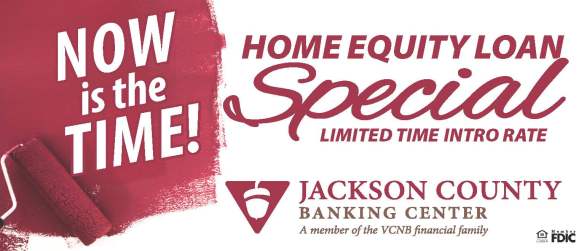
JCBC Billboard - HELOC Now is the Time - (Jackson Digital)

How long is your home improvement wish list? Is there something special you would like to do that would make your home perfect? Is it the bathroom of your dreams or a bigger kitchen to accommodate your growing family? Maybe you want a more spacious family room or a pool so your home can be the hangout for all the neighborhood teens?

Whatever it is you would like to accomplish, here at VCNB we believe that now is the time to make those dreams a reality. Now through June 30, open a new home equity line of credit to receive an introductory annual percentage rate (APR) of 3.99 percent for the first twelve months.

If you have equity in your home, why not use it to make your house the home you’ve always wanted it to be? See below for the terms of this promotion and click here to get started! 

This promotion is available April 1, 2018 through June 30, 2018. The introductory Annual Percentage Rate (APR) will be fixed at 3.99% for the first (12) months from the note date and will be terminated at the end of the twelve (12) month period. After the introductory period, the loan will become a variable rate loan. The subsequent APR may vary from Prime Rate (index) to Prime Rate plus 0.25% (margin is dependent on loan-to-value ratio). Prime rate is based on the current rate published in the Wall Street Journal. As of March 22, 2018 that rate was 4.75%. The current APR using the prime rate plus the 0.25% margin is 5.00%. The APR will never exceed 18.00%. This promotion applies only to new lines of credit. Promotion available for single family, owner-occupied, primary residence only; excludes manufactured properties. Minimum line amount of $10,000 is required. Maximum loan-to-value ratio is 89.00%. After the initial 12 month period there is a $50.00 annual fee. Title Insurance and Survey Fees will be assessed to borrower for loans of $100,000 or greater. Fees range between $350.00 and $1500.00. Property and flood insurance will be required, if applicable. Applicants must successfully meet our Home Equity Line of Credit underwriting standards. Not all applicants will qualify for this promotional offer. Alternative rates and terms are available. NMLS #483350


Now Is The Time To Buy!

FBBC Billboard - Home Loan Now is the Time Alt (Nauman Digital)

Buying a home isn’t a decision to be made lightly. However, if you’re thinking about buying this year, now is the time to buy and finance your new home with VCNB.

Here at VCNB we have experienced lenders who will help you along the way. Plus, now through June 30, qualified borrowers will receive a $500 closing cost credit with a new home purchase mortgage!

The $500 Closing Cost offer is valid for applications received April 1, 2018 through June 30, 2018. This offer is only available for purchase mortgage transactions of a new, single family, owner-occupied primary residence. All loans are subject to underwriting and property approval. Not all applicants will qualify for this promotional offer. The $500 closing cost offer will be in the form of a lender credit and will be applied at the time of closing. Other restrictions and limitations may apply.

What are you waiting for? There is no better time than the present to finance your new home with VCNB! Click here for details and to find a lender in your neighborhood!

NMLS# 483350

How to Save for a Down Payment

The tallest hurdle to buying your first home will be saving for the down payment. To avoid having to purchase private mortgage insurance, you’ll likely need to put down at least 20% of the purchase price, which will probably mean tens of thousands of dollars.

As a young adult, saving this much money may seem impossible — like climbing a mountain. When you climb a mountain, it looks huge from afar. But if you take one step, then another, pretty soon you’ve reached the top, and the view is great.

Figure out how much you need to save
No matter the amount you have to save, approach it as a challenge. First, figure out exactly how much house you can really afford with the help of a home loan calculator. The calculator uses your inputs (income, expenses, debt) along with local tax data to recommend how much home you can afford — and how much of a down payment you’ll need.

Figure out what you spend now
If you don’t know exactly what your monthly expenses are, track all your spending for a month and analyze it to see where you can cut back. Think realistically about what you can sacrifice each month to reach your savings goal.

Cut out the small stuff
By now you’ve probably heard you should skip the daily latte and brown-bag your lunch, but those are savings cliches for a reason: They really do add up.

Something else that can add up: using coupons for your grocery shopping. Get familiar with the BOGO (buy one, get one) days at your local stores. With smartphone apps, you no longer need to clip and save paper coupons to present at checkout.

To save money on entertainment, rent movies through a subscription service such as Netflix or, even better, check out movies from your library. Libraries also frequently offer lectures, book groups and kids’ programs. Look for other free community events at your local parks and take advantage of free-admission days at museums.

Find a high-yield savings account
Earning as much interest as possible will help ignite your savings. You can find high-yield savings accounts at Internet banks, credit unions or community banks. When you open the account, add an automatic withdrawal from your paycheck so you won’t be tempted to spend money earmarked for the down-payment fund.

Sell what you don’t need
You might want to declutter before you move into your first home, so why not start by selling stuff you don’t want or need? If your neighborhood puts on a community garage sale, join in. Or sell your unwanted stuff on eBay, Craigslist or via a Facebook “virtual garage sale” page for your area.

Enlist family and friends
No, don’t ask your friends to give you money. Instead, let them know that saving for the down payment is your No. 1 priority. If your friends want to go out for dinner, suggest you get together for homemade pizza or a potluck at home. Chances are you’ll have a much more memorable evening.

The bottom line
Saving for a down payment can seem like a high mountain to climb, but if you look at it as a challenge, it can also be fun. And just imagine the feeling of accomplishment when you’re relaxing someday in a home of your own.

© Copyright 2016 NerdWallet, Inc. All Rights Reserved

How to Tell You’re Ready to Buy a House

Making the decision to become a homeowner is emotionally and financially complex. Here are some key things to ask yourself if you’re considering whether buying is right for you.

Do you have a good reason to buy?
Sometimes switching from renting to buying is a no-brainer.  Maybe you live in a modern one-bedroom apartment in a chic part of town, but you have a baby on the way. If you want a place in a good school district, with more square footage and a yard, buying may well be your best bet.

Other times, the urge to buy is driven by emotion: You see a house you like and you “just know.” There’s nothing wrong with that reaction, but take time to check out the property before you make any commitments. If it’s too far from work, near a noisy road or the best house on a bad block, it may not be as good a deal as it first appears.

And remember: Houses go on the market all the time, and there are tens of millions of single-family homes and condos in the U.S. So there’s no need to worry if your first choice doesn’t work out; your home is out there.

Can you make the upfront investment?
Buying a home requires an initial investment that you can’t ignore.

First, many lenders require a down payment of 20% of the home price. That’s $40,000 for a home that costs $200,000, about the median price in America. You’ll also owe closing costs, which could include loan-origination fees, discount points, appraisal fees, survey fees, underwriting fees, title search fees, and title insurance. Those could total another few thousand dollars.

The expenses don’t end there. You’ll want to hire an independent inspector to look for defects in a home before you buy.  This will cost several hundred dollars, but could save you thousands in repairs. And then there are moving costs, state or city taxes, utilities installation and the costs of changes you might want to make to the home — such as new flooring or painting — that are easiest to do while it’s empty.

This isn’t meant to scare you off; buying a home is still a smart choice for many people, despite the costs. But it does take a lot of cash.

Can you afford the upkeep?
Your mortgage payment might be fixed for the next 30 years, but your property taxes and insurance rates can rise. And if you didn’t make a 20% down payment, you’ll have to buy private mortgage insurance, or PMI, until you have 20% equity in your home. It costs about $165 per month on a $200,000 loan.

Once you’re a homeowner, you’ll also have to pay certain utility bills that might have been included in your rent. And you’ll be responsible for maintenance: double-pane windows one year, a new garage door the next, fixes to the roof five years up the road. It adds up.

These numbers are based on averages.  Plug your specific figures into a rent-or-buy calculator to find out if you’re ready for homeownership. And know that there is no one answer that’s right for everybody. Whether you keep renting or buy, your decision should be right for you alone.

© Copyright 2016 NerdWallet, Inc. All Rights Reserved


Four Reasons to Buy a Home Instead of Renting

The financial benefits of buying a home compared with renting have yoyoed over the years, especially of late. If you’re sitting on the fence, here are four circumstances in which it may be a better bet to buy.

If interest rates remain low
From a financing perspective, if this isn’t the best time to buy a house, it’s pretty darn close.

The average interest rate on a 30-year fixed mortgage, the most common variety, has hovered below or near 4% for several months now. For comparison’s sake, if you bought 10 years ago, the average interest rate was 6.41%. In 1996, it was 7.81%, and in 1981 it was a whopping 16.63%.

Although the Federal Reserve has begun to inchrates upward, it is likely that it will do so slowly and that it will be a while before the cost of borrowing to buy a home stops being historically low.

If home prices level off
Home prices rose steadily in the 1970s, ’80s, ’90s and 2000s before plunging around 2007, and in the past few years they have been climbing again. Different markets have seen different trends, of course, but generally what’s at play is supply and demand: More potential buyers than houses available means sellers can dictate terms and get top dollar.

But something interesting is happening: The oft-told story that millennials are renting for longer or living with their parents nowadays is not entirely accurate. No, people in this age group (born between 1981 and 1997) want very much to own a home, but they are putting it off because of real and imagined difficulties in affording it.

That could mean fewer potential buyers and a cooling of the upward surge in home prices. While others wait, you could pounce.

If rental costs continue rising
Real estate researcher Reis Inc. reports that apartment rents rose 4.6% in 2015. In hot housing markets such as California and the Pacific Northwest, rents are going up by about 14% per year.  According to Zillow, the median asking price nationwide for a rental was $1,575 per month in early 2016.

The monthly payment on a $200,000 mortgage — about the average in the U.S. — with a 4% interest rate would be just over $950. Even with taxes, insurance and maintenance, it’s tough to make a financial case in favor of renting.

If you want to save money
Home values over the past 70 years have generally tracked with inflation. Yes, you could make more money in the stock market. But we’re talking real life, not investment advice. Consider two things:

  • Your rent is locked in for a year or two, then will go up. Your mortgage payment can be the same for 30 years.
  • If you are raising a family, it seems all but impossible to save money. But when you sell the house after 30 years (or 20 or 10), someone will hand you hundreds of thousands of dollars, money that could put the kids through college or finance your retirement.

© Copyright 2016 NerdWallet, Inc. All Rights Reserved

Why Teens Need a Checking Account

VCNB began offering a student checking account a few years ago in response to a growing number of teens and parents who requested it. There is significant value to a teenager having an age appropriate checking account and we are optimistic that this generation of teens will be more financially savvy because of it.

After all, a teen will be an adult in a few short years. Whether they are headed straight to the workforce or to higher education, your teen soon will experience some degree of independence. Helping them establish good money habits at a young age is an important way to give them a good start to adulthood.

Here’s some food for thought:

Expense tracking and budgeting
Having a checking account teaches teenagers the very basic of skill of not spending more than they have as well as how to record expenses and debits. In general, it helps them develop budgeting skills they will use for a lifetime.

Independence, good habits and financial responsibility
As a parent, you have spent years managing every aspect of your child’s life. While you may not like to think about it, soon your teen will be an adult who needs to make responsible decisions. Independence starts in the teen years and helping them make sound decisions with their money is part of preparing them for adulthood. Habits are created every day – work with them and use a checking account to teach them good ones

Safer than cash
We notice that many of our student checking accounts are opened by teens who are going on school field trips, sometimes out of country. It’s far safer to travel distances or even just around town with a debit card than with a pocketful of cash.

Check out this link to learn more about Student Checking My Way at VCNB. You’ll find this account listed under the Checking Accounts tab.